Table Of Content
“I really feel like the dining room is a forgotten room,” says the designer, who set out to prove how vital the space is to a home. The room is anchored by a Riva 1920 table made with the wood of a 50,000-year-old Kauri tree, which Levine surrounded with seating for 12. Another seating area with views of the garden was designed for more intimate dining, games, or meetings, and it’s illuminated by a Murano glass chandelier. At the far end of the room, Levine installed a lush purple sofa with cocktail tables, creating the perfect spot for drinks, dessert, or relaxing with a cup of coffee.
Energy-Efficient Houses
Just inside the inner wall there is often a cavity containing all the wiring and ducting. Passive design is a holistic approach that takes every last factor into account, down to heat emissions from appliances and occupants. The best way to build passive is the Phius standard and accounts for the overwhelming majority of passive buildings in North America. Proper mechanical system selection and commissioning is critical to maintaining comfortable and safe moisture levels inside passive buildings. High performance enclosures in passive buildings require attention to detail when it comes to appropriate vapor control design. Airtightness is cornerstone to passive building design for both durability of the enclosure as well as energy savings achieved by minimizing infiltration of outside air and loss of conditioned air.
• High Performance Windows + Doors
Furthermore, residential buildings account for more than 20 percent of energy consumption in the country, according to the U.S. Department of Energy, and each household releases about 8.7 tons of carbon dioxide per year. As concern over interrupted service, financial impacts, and sustainable solutions grows, the demand for more efficient and resilient homes is also growing.
What Is a Passive House? Principles and Design
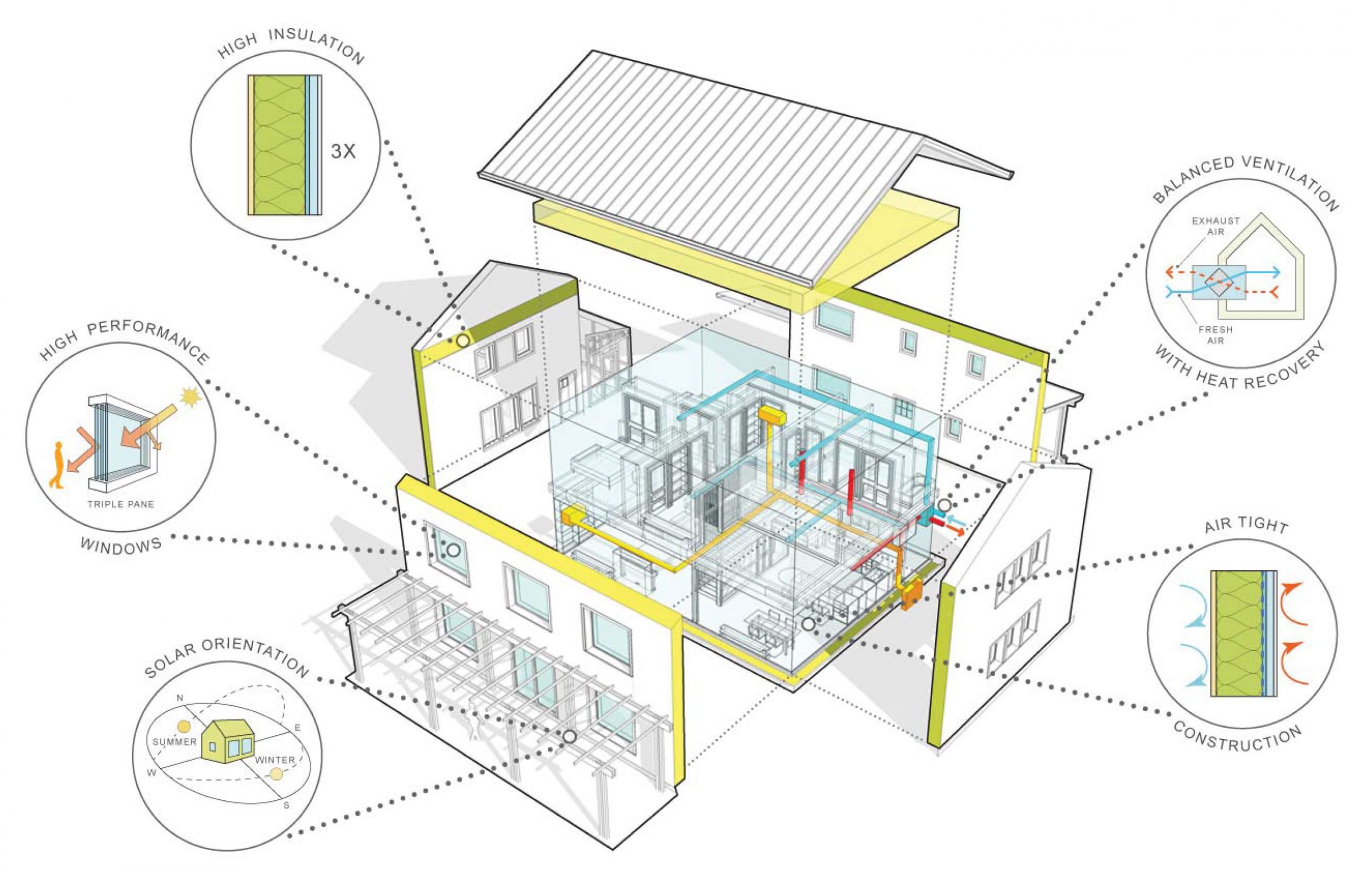
Passive House designs can look like any conventional building, although to minimize thermal bridges, they are often simpler and boxier minimalist forms. Phius' comprehensive approach to design, construction and quality assurance results in buildings that are resilient and built to last. Superinsulation and airtight construction means you're always comfortable, no matter the weather outside.
Skyscraper in Boston is now the largest 'passive house' office space in the world - WBUR News
Skyscraper in Boston is now the largest 'passive house' office space in the world.
Posted: Thu, 05 Oct 2023 07:00:00 GMT [source]
“I thought, if somebody’s taking care of the baby, they have a space where they can come and feel like it’s a retreat,” Sabatella says. The designer outfitted a door handcrafted in India with a vintage mirror to create a one of a kind headboard and bathed the space in deep emerald green. The glamorous touches continue in the ensuite bath, where Sabatella added a custom mirror-tiled tub that plays off the vintage French tile floor. Bursts of hot pink and apple green energize Steven Cordrey’s design for the home’s veranda.
However, passive houses generally cost more to build than conventional buildings, although the energy savings over time can offset this initial cost. Passive houses accomplish all this with green strategies, including super insulation, airtight construction and high-performance windows. Passive house design strategies can be used in any climate and in both new and existing buildings, including hospitals, schools and high-rises.
Passive House standards in the US - Passive House Standard and PHIUS+
Passive building principles offer to best path to net zero and net positive buildings, because they are built correctly from the start, reducing the renewables load. Large buildings can achieve certification more easily thanks to efficiencies of scale, and carry lower cost premiums than smaller ones. No, they aren’t bound to any specific style, but they have defining features, such as thick walls (which allow for super insulation) and triple-glazed windows. Design-wise they take many forms, from traditional to modern and from simple to complex. The banquet room, with sliding doors and rich textures, provides a private yet connected area.
Does a Passive House Need a Ventilation System?
In 2011, PHI cancelled its contract with PHIUS for misconduct.[45] PHIUS disputed the claims by PHI and continued working to launch an independent building performance program. The specific heat load for the heating source at design temperature is recommended, but not required, to be less than 10 W/m2 (3.17 btu/(h⋅ft2)). Olivia Young is a writer, fact checker, and green living expert passionate about tiny living, climate advocacy, and all things nature.
All You Need to Know About Tudor Style Homes, Then and Now
In dry locations, like the prairies, buildings without humidification in winter can leave the interior spaces at low interior humidity (under 30% RH), which leads to discomfort, potential health issues, and damage to interior materials. Unlike HRVs, which only transfer heat, ERVs can also transfer moisture from the outgoing exhaust to help maintain more-comfortable moisture levels in interior spaces. Occupants can also utilize natural ventilation (using cool summer breezes) from opening windows to exchange stale air by nonmechanical means and are encouraged to do so when it makes sense. Passive House designs utilize both methods to keep ventilation energy to a minimum. Yes, conceptually, an existing structure can be retrofitted to conform to passive house standards.
The roof is covered in green plants that help the house blend in with the surrounding woods. The slanted frame and ample windows mean the house stays warm in the winter and cool in the summers. Not only does this house look incredible, but it is also almost entirely neutral in terms of its energy usage. Their assemblies have been tested in eight different climate zones in northeastern U.S. and across Canada—and the resulting building plans are viable in those climates. The first home built to Passive House standards in the US was completed in 2003 by Katrin Klingenberg in Urbana, Illinois.
Worldwide, it is arguably the strictest energy efficiency standard for buildings. Passive buildings achieve air control by air sealing the enclosure and then providing balanced, mechanical ventilation to achieve superior indoor air quality. Thermal control involves keeping the inside of a home warm when it is cold outside and cool when it is hot outside. One way of achieving this is by having a high-performance enclosure, which includes continuous insulation throughout the entire building to reduce heating and cooling needs. While many people think passive house design originated in Germany, the passive house movement actually began in the United States and Canada in the 1970s following the 1973 oil embargo that hiked up energy prices. This spurred a group of engineers and architects to design a highly insulated house in 1976 that consumed 60 percent less energy than any other building.
A building’s air barrier is a layer of material (membrane, tape, seals) around the envelope that restricts the movement of air in and out of the building. Minimizing repeating thermal bridges and aiming for continuous insulation where possible, as in the assemblies shown in Figure 1, helps make the most of the insulation within the building envelope. Achieving Passive House levels of heat resistance is not just about how much insulation you have, but whether that insulation is used effectively.
There are passive houses of all shapes and sizes located everywhere from Serbia to New York. Each one of these homes is unique in its own way and can provide a boatload of inspiration for anyone interested in green energy design. EnerPHit is the passive house certification system for existing homes going through a renovation or retrofit. While it uses many of the same principles and processes as the traditional passive house certification program, it has less rigorous metrics for achieving performance and energy efficiency. Some steps include insulating the foundation, replacing windows with high-performance models, installing ventilation with heat recovery in mind, incorporating renewable energy sources, and addressing drafts.
The Shanghai Transaction Succeed Office, designed by One House Design, reimagines office space with a focus on combining multiple functional areas. The design explores the combination and interaction of multiple spaces by excavating the distinctive features of the company, and by extracting, breaking down, and developing from the elements of its logo. Repeating organic forms, undulating silhouettes, and multi-dimensional mapping overlap create a fluid space that mimics a wormhole.
Additionally, passive houses tend to be more comfortable and quieter than conventional buildings. Passive house design principles are gaining traction worldwide as an effective way to minimize energy consumption in buildings. Typical homes allow unwanted flows of energy between the exterior and interior. PHLA+ is a project designed by PARAVANT Architects strategically planned to showcase the international passive house construction standard.